
February 11, 2015
Early in my career, my great uncle asked me about my new role at a publicly traded company. He was a retired engineer who spent his entire career at Exxon, so he knew what it is like to work in the corporate world. Apparently, I gushed to him about it because he said, “I can tell you love your job because you are so enthusiastic about it.” He was right, I was enthusiastic about it, and that enthusiasm lasted nearly a decade until circumstances changed and I found a better opportunity.
Since then, I’ve managed, supervised and worked with a variety of people who have an assortment of skills, capabilities, and backgrounds. I have found that an employee’s dedication and attitude are much more important than his or her specific skillset and a better indicator of job success. Interestingly, the research in this area supports my practical experience and perceptions.
I think we can all agree that it is better to work with “engaged employees” than ones who are burnt out. If you're interested in reading the research, Dr. Hazen Witemeyer discusses employee engagement in her dissertation: Witemeyer, Hazen A., "Employee Engagement Construct and Instrument Validation" Dissertation, Georgia State University, 2013. I have summarized some takeaways from her work below.
My article is broken into three parts: (i) defining employee engagement, (ii) describing the benefits of employee engagement, and (iii) describing employee engagement techniques. Although technical, it is important to define engagement, so we can recognize it when we see it:
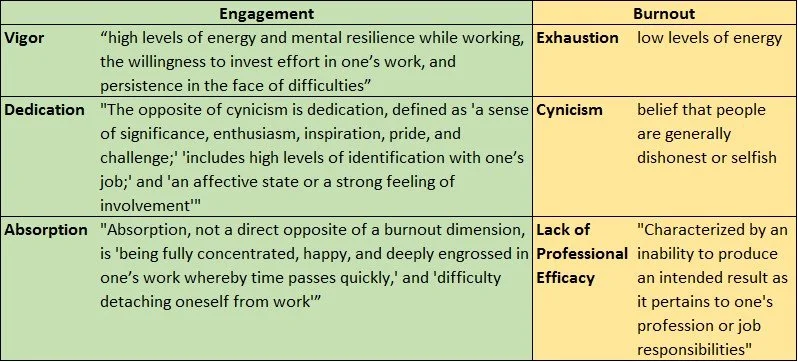
Work Engagement is defined as "a positive, fulfilling, work-related state of mind that is characterized by vigor, dedication, and absorption,” which is a “persistent and pervasive affective-cognitive state that is not focused on any particular object, event, individual, or behavior”
Engagement is characterized by an employee’s vigor, dedication and absorption, as defined above and summarized in the chart below. The opposite of engagement is burnout, which is characterized by employee exhaustion, cynicism and a lack of professional efficacy:
Dr. Witemeyer’s research shows that engaged employees exhibit desirable behaviors. Furthermore, this “good behavior” is believed to add to the bottom line. From the research, some examples of the benefits based on practitioner interviews follow:
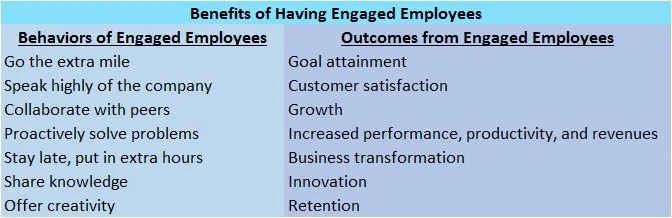
The research supports the concept of “a two-way relationship underpinning employee engagement.” In this relationship, management offers employment and all that goes along with it, while the employee offers services. Recognizing that an exchange exists is the first step toward employee engagement.
I have high expectations for the people with whom I work and for the organizations with which I work. For the people in my part of the organization, I like to see hard work, dependability, and appropriate initiative. In exchange, I offer my accountability, responsiveness and leadership to them. What my employees are providing me in the abbreviated list above represents the sum of the parts of their technical performance—how they do their job.
Employee engagement offers more than just minimum job performance, though. In the movie, Office Space, Jennifer Anniston’s character, Joanna, is derided by her boss, Mike Judge's character Stan, for wearing only the minimum 15 pieces of flair. In contrast, Todd Duffey’s character, Brian, wears 37 pieces of flair. Engaged employees wear more flair.
The scene illustrates that simply making rules doesn't result in employee engagement. Maybe Office Space’s Joanna would wear more flair and be more engaged if her employer fulfilled its end of the bargain.
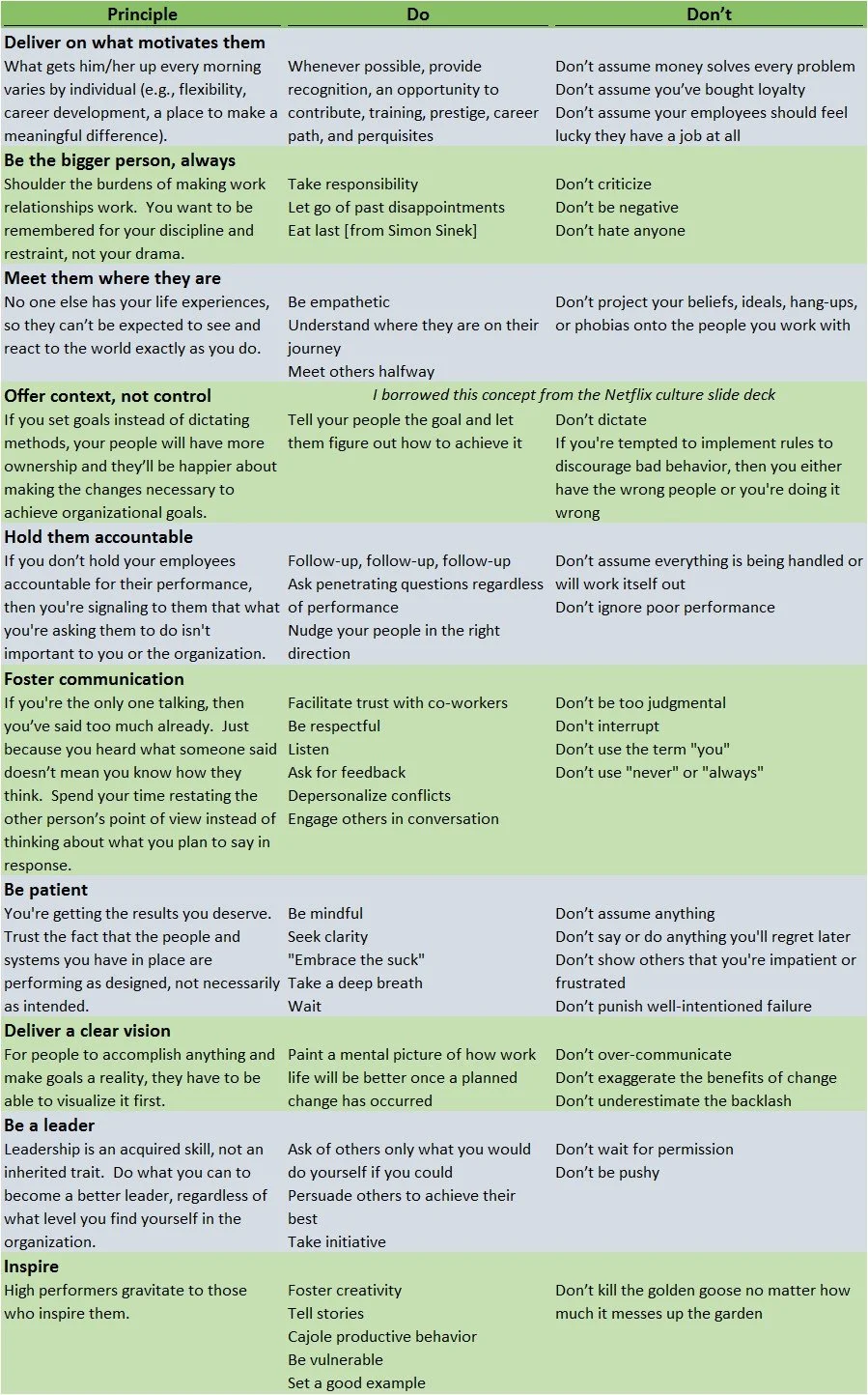
To that end, I’ve compiled a list of ways to stimulate better employee engagement. Wherever you are on the organization chart, use the following actions to improve employee engagement:
I once worked with a woman who was disengaged from her work. “Sheila” reported to one of my direct reports. Everyone warned me that she had one foot out the door and wouldn’t be around much longer. As far as I could tell, Sheila did good work.
Sheila was frustrated by her immediate supervisor, “Todd.” The same people who told me Sheila would be leaving also told me that Todd—my subordinate—had a “tin ear” when it came to personnel management issues. Clearly, the “two-way relationship” between Sheila and Todd wasn’t healthy. It had broken down.
Around the same time, I needed someone in my group to perform the cash management function, so I recruited Sheila to the job and changed her reporting relationship so she reported directly to me. Even though she was a CPA and didn’t have treasury experience, she dived into this new endeavor with enthusiasm. With my guidance, Sheila did very well in her new role. She became engaged in her work, and I could always count on her to deliver results.
Sheila’s first love is accounting, not treasury or cash management. Nevertheless, she helped make a meaningful contribution to the organization while adding to her skill set. This is just one example where attitude trumped experience.
I’m still learning how to be a better manager. For example, I'm teaching my teenage daughter how to drive a car. It takes a lot for a control freak like me to give up the keys. After a few missteps, my daughter and I have reached détente, and we’ve achieved a healthy two-way relationship as it pertains to driver’s education.
One of the things about driving that I take for granted is difficult to teach or even articulate: My right foot isn’t always mashing the gas or slamming on the brakes. There are graduations of both and even an in-between point where my foot is hovering between the two pedals.
Management of people is a bit like driving a car. Like driving skills, no one is born with people skills, and it takes years of practice to be really good at either of them. When I was new to management, in my 20s, sometimes I mashed on the gas (encouraged behavior) or slammed on the brakes (discouraged behavior) at the wrong times or with the wrong intensity. Fortunately, I worked with forgiving people and I eventually learned from my mistakes without wrecking the “family car.”
Maybe you've had similar experiences you would like to share. What lessons have you learned as a manager or subordinate? What principles would you add to the list above? Ever had things go exceedingly wrong (akin to wrecking the family car)? Do you have any success stories to share? Please comment below.